Friday, February 14, 2014

Windows 8 Transformation Pack 4.0 Free Download

By Sonu Kumar Gupta   Posted at  5:40 AM   Windows No comments


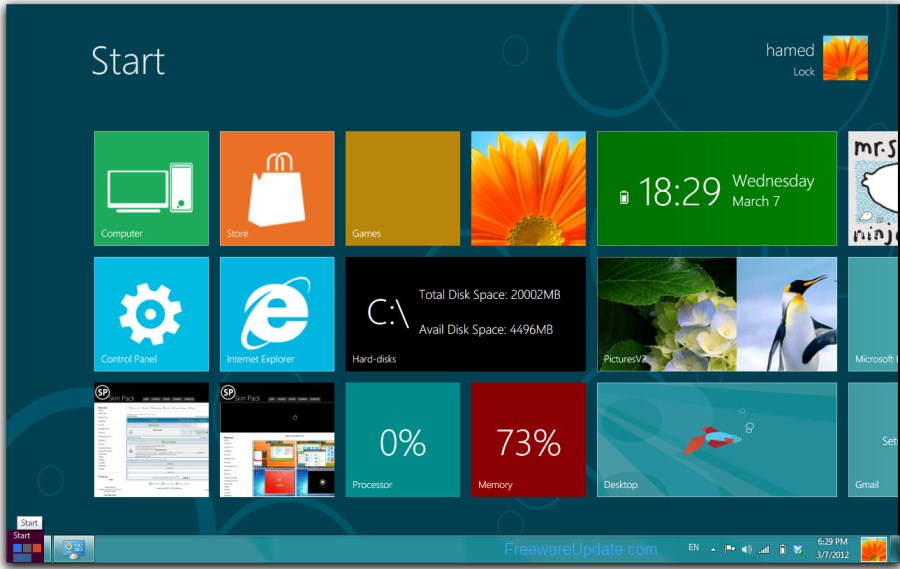
Windows 8 Transformation Pack (8TP) will transform your Windows 7/Vista/XP user interface to look like Windows 8


Windows 8 Transformation Pack 4.0 FreeDOWNLOAD
Note: Please remove the extra _ in the downloaded file name (if any).
File Name: 8TP4.zip | Size: 56.4 MB | Proper Release: 11-Apr-2012


8TP v4.0 Proper Notes

  • Fixed Segoe fonts family installation that fails to update in some Vista/7 platforms
  • Optimized Metro Inspirat resources to work properly on low memory Windows XP machine


What's new in 8TP v4.0

  • Added Charms Bar as alternatives for those who can't get full Immersive UI to work
  • Added new Segoe family fonts from Windows 8 Consumer Preview with Windows Vista/7 font update support
  • Improved system files modification framework (More secure and safe to handle)
  • Fixed disabling system files modification that won't work on installation
  • Fixed explorer not restoring after choosing to cancel restart during configuration
  • Fixed permission problems in some programs that perform changes in Program Files
  • Fixed system files modification bug in Program Files on x64 platform
  • Fixed unchecking large icon doesn't restore icon size bug
  • Fixed uninstallation script that removes legacy theme registry
  • Updated component UI font to Tahoma and info font to Segoe UI
  • Updated default Metro Desktop UI option to Immersive UI with Charms Bar as default option
  • Updated default pictures of guest and user to Windows 8 Consumer Preview ones
  • Updated Metro Inspirat Windows XP visual style to version 3.0
  • Updated Newgen to version 8.0
  • Updated Newgen UI to match with Windows 8 Consumer Preview
  • Updated system files resources
    • logon screen
    • shell branding and logo
    • shell icons
    • start button/orb
    • system tray icons
  • Updated TrueTransparency skin based on Windows 8 Consumer Preview default color
  • Updated wallpapers to Windows 8 Consumer Preview ones
  • Unchecked 'Aero's auto-colorization (Vista/7) only' feature to get Windows 8's default colorization
Screen


image
 

Download Adobe Photoshop CS6 + serial

By Sonu Kumar Gupta   Posted at  5:33 AM   Graphics and Designing Softwares No comments

It's been two years since Adobe unveiled a new version of Photoshop,
so it shouldn't come as a surprise that the company's engineers have
been toiling away behind the scenes on a major update. The outfit's
clearly ready to start showing off the fruits of its labor, though, as
it just unveiled the beta version of CS6. All told, the outfit's added
65 user-feedback-inspired features, including a new crop tool, expanded
video editing options, auto recovery and the ability to search for
specific layers. Fans of the dotted lines in Illustrator now get the
same vector tools in Photoshop. Additionally, every slider for the
Camera Raw 7.0 plug-in (exposure, contrast, etc.) has a freshly tweaked
algorithm. And for anyone who's ever looked on helplessly as Photoshop
locked itself up during a long file save, projects can now save in the
background while you work on other things. Looking for more info? A
brief rundown of the beta and a full list of new features await you just
past the break.


Image


Adobe's
also made some refinements to existing features. The liquify tool, for
instance, now has a larger maximum brush size, and works in real time so
you can see the effect in real time. Adobe's also added two features to
complement Content-Aware Fill, which was first introduced with CS5.
These include one for moving objects to different part of the image, and
one for patching up a spot with content taken from another part of the
picture.


Image


With
change comes some potential readjusting, though. In addition to adding
more functionality, Adobe's overhauled the UI so that it has a dark
background by default (this is customizable, to an extent) with a
generally cleaner smattering of icons and menus. Even the setup process
has been overhauled: now, users must sign in with an Adobe ID before
installing the software. Though there are contingencies for people
without an internet connection, the idea is that people will enjoy more
efficient support if they don't have to fumble around for a long-lost
serial number.


Image


There's
one thing that hasn't changed and that's pricing. When this goes on
sale it'll cost $699 as a standalone product, and $999 for the extended
version. For now, though, you can download the free beta (it's only
available as an English- and Japanese-language program for now). If you
only have two minutes, we've also got the full PR after the break, along
with an official list of new features and tweaks.


Billy Steele contributed to this report.


New Features


Brushes

- HUD brush resize and hardness can now change opacity

- Increase brush size to 5000px

- Change color dynamics to per stroke instead of per tip (user option for old behavior)

- Brightness/contrast slider for textures when painting

- Brush projection for static tips

- Brush cursor reflects brush dynamics for round and captured tips


Eyedropper

- Show the sample size popup for the various eyedropper tools (black point, white point,

etc.)

- Add ignore adjustment layers options bar item for the eyedropper

- New mode for eyedropper to select layers current and below


File formats

- Read common stereo image pair formats (JPS, PNS) Allow for more bit depths in TIFF files

- Read BIGTIFF format

- Give the user choices regarding how they want transparency treated in OpenEXR on file open


Grammar

- Policed throughout app

- Use consistent grammar style in the title of dialog windows (no commands such as "Choose a color:")


Layers

- Add a contextual menu item that deletes a layer effect not just disables it

- Add dither options to Layer Styles for Gradient Overlay and Gradient Stroke

- Allow 00 or Shift 00 to work when setting layer/fill opacity (previously no way to get 0%)

- Add bicubic sharper & bicubic smoother options when free transforming layers

- Allow changing of blend modes for multiple layers at once

- Allow locking of multiple layers

- CMD+J to duplicate layers and layer group

- Allow changing color labels to multiple layers at once

- Layer tooltips to include layer name (if defined)

- Opt+click on toggle arrows (groups and effects) in layer panel should close all targets

- Show blend if/Blending Effects badge on layer

- Show correct opacity and blend mode values for hidden layers

- Tab goes to next layer on inline layer rename, SHIFT + TAB goes to previous

- New command to raster layer effect into layer, merging the selected layers into themselves

-
Reorder effects in the layers palette to match the Z-­­order
style/blend mode (bottom most effects in termsof blending order, drop
shadow is below the other effects


Liquify

- Resize Liquify brush with shortcuts

- Increase maximum Liquify brush size Add option to load last mesh


Presets

- Add new document presets for common devices (e.g. iPhone, iPad, etc.)

- Add new Gradient Map presets for toning and split-­­toning

- Sticky reorganization of tool presets (changes persist after re-launch) Add Contact Sheet II as an Automation option


SDK

- Add the ability to return an array of guides in a document from the scripting SDK

- Add ability to access tool name associated with the tool preset name via scripting

Selections

- Make the marquee, lasso, and mask panel feather values support decimal places like the feather dialog

- Remember feather radius when showing dialog for selection from a path


Transform

- Improve dragging of vector curves

- Don't hide smart object icon when transforming a layer

- Rotate 90 with even x odd pixel dimension to be smooth (bjango.com)

- Undo or disable auto -­­rotate on open


UI

- Remove the app bar and reduce the drag/app bar over 30%

- [Windows] New/open document to context click on a document tab (has always been on Mac, now Windows too)

- Add "Don't show again" checkbox to Purge warnings


Miscellaneous

- Enable Split Channels for documents with layers

- Select Hex field by default and allow clipboard pastes with # in contents (i.e. #fffffff)

- Increased GPU stability by prequalifying GPUs on the fly before use

- Auto-­­select the best resample method based on the type of resize

- Enable Invert and Threshold adjustments for masks in 32 -­­bit

- Hold SHIFT during startup to disable 3rd party plugins

- Add warning message that 16 -­­bit images cannot display their file size in the Save as JPEG dialog

- Add command to insert "lorem ipsum" for type


image
 http://adfoc.us/20552638330165
  
DOWNLOAD SERIAL KEYS

Monday, February 3, 2014

Class 11 Chemistry Notes GOC - Intermediates of Organic Compounds

By Sonu Kumar Gupta   Posted at  12:47 AM   Notes and keys No comments

Intermediates of Organic Compounds
Class 11 Chemistry Notes GOC   Intermediates of Organic Compounds
Electronic Displacement Effect:
It is an effect which exists due to the displacement of electron in specie.

These effects can affect stability of compounds and its properties like acidic nature and basic nature. It can also affect the strength of acidic and basic nature of any compound.
Electronic Displacement Effect can be basically divided into two parts:-


  1. Permanent effect
  2. Temporary effect
Permanent effect includes:
  1. Inductive effect
  2. Mesmeric (resonance) effect
  3. Hyper conjugation whereas
Temporary effect:
  1. Electromeric effect
  2. Inductomeric effect


Class 11 Chemistry Notes General Organic Chemistry

By Sonu Kumar Gupta   Posted at  12:45 AM   Notes and keys No comments

General Organic Chemistry is like soul for preparation of organic chemistry.
First we will see how bond breaks and what the different reasons behind bond breaking.
There are basically two types of bond fission:
  1. Homolytic Bond Fission
  2. Heterolytic Bond Fission
Homolytic Bond Fission:
Homolysis: The bond cleavage in which each bonded atom gets their own contribution
Class 11 Chemistry Notes General Organic Chemistry
  • Cleavage takes place due to HELP (H = Heat, E = Electricity, L = Light, P = Peroxide)
  • Favored when Electro negativity difference is zero.
  • Cleavage takes place in non polar solvent.
Heterolytic Bond Fission:
Class 11 Chemistry Notes General Organic Chemistry
  • It is formed when the electronegativity difference between the bonded atoms is high.
  • Formation is favored by polar solvent
Class 11 Chemistry Notes General Organic Chemistry
  • Positive charge of the solvent attracts the Negative pole of compound and the
  • Negative pole of the solvent attracts Positive, and the bond breaks.


Class 11 Chemistry Notes Stocihiometry - Important Question Answers

By Sonu Kumar Gupta   Posted at  12:43 AM   Notes and keys No comments

Ex. A volume of 12.53 ml of 0.051 M SeO2 reacts exactly with 25.5 ml of 0.1 M CrSO4 which is oxidized to Cr3+ To what oxidation state was the selenium converted b the reaction.
Sol.
Class 11 Chemistry Notes Stocihiometry   Important Question Answers

Ex. In basic solution CrO42- ion oxidizes S2O32- ion to form Cr(OH)4- and SO42- ions respectively. How many ml of 0.154 Na2CrO4 solutions are required just to react with 40 ml of 0.246 M Na2S2 O3 solutions.
Sol.
Class 11 Chemistry Notes Stocihiometry   Important Question Answers
Ex. What mass of N2H4 can be oxidized to N2 by 24 gm of K2CrO4 which is reduced to
Sol.
Class 11 Chemistry Notes Stocihiometry   Important Question Answers

Ex. The ion An+ is oxidized to AO3- by MnO4- changing to Mn2+ in acid medium. Given that mole of An+ required mole of MnO4-. What is the value of n.
Sol.
Class 11 Chemistry Notes Stocihiometry   Important Question Answers

Ex. 25 ml of 0.17 M HSO3- in strongly acidic solution required the addition of 16.9 ml of 0.01 M MnO4- for its complete oxidation to SO42-. In neutral solution it requires 28.6 ml. Assign oxidation no. of ‘Mn’ in each of the products.
Sol.
Class 11 Chemistry Notes Stocihiometry   Important Question Answers
Ex. A given amount of Fe2+ is oxidized by x mol of MnO4- in acidic medium. Calculate mol of Cr2O72- required same amount of Fe2+ in acidic medium
Sol.
Class 11 Chemistry Notes Stocihiometry   Important Question Answers
Ex. Calculate mol of (a) MnO4- and (b) Cr2O72- to oxidize 1 mol of FeC2O4 (ferrous oxalate) in acidic medium.
Sol.
Class 11 Chemistry Notes Stocihiometry   Important Question Answers

Ex. A mixture of Na2C2O4 and KHC2O4. H2C2O4 required equal volume of 0.1 M KMnO4 and 0.1 M NaOH separately. What is the molar ratio of Na2C2O4, KHC2O4 and H2C2O4 in the mixture?
Sol.
Class 11 Chemistry Notes Stocihiometry   Important Question Answers

Ex. 5.5 gm of a mixture of FeSO4. 7H2O and Fe2 (SO4)3. 9H2O requires 5.4 ml of 0.1 N KMnO4 solutions for complete oxidation. Calculate the no. of gm moles of hydrated ferric sulphate in the mixture?
Sol.
Class 11 Chemistry Notes Stocihiometry   Important Question Answers


Class 11 Chemistry Notes Stocihiometry - Glossary

By Sonu Kumar Gupta   Posted at  12:41 AM   Notes and keys No comments

Aliquot. A portion of the whole, usually a simple fraction. A portion of a sample withdraw from a volumetric flask with a pipet is called as aliquot.
Analytical concentration, The total number of moles per litre of a solute regardless of any reactions that might occur when the solute dissolves. Used synonymously with formality.
Equivalent. The amount of a substance which furnishes or reacts with 1 of H+ (acid-base), 1 mol of electrons (redox), or 1 mol of a univalent cation (precipitation and complex formation).
Equivalent weight. The weight in grams of one equivalent of a substance.
Equivalence point. The point in a titration where the number of equivalents of titrant is the same as the number of equivalents of analytic.
End point.The point in a titration where an indicator changes color.
Formula weight. The number of formula weights of all the atoms in the chemical formula of a substance.
Formality. The number formula weights of solute per liter of solution; synonymous with analytical concentration.
Indicator. A chemical substance which exhibits different colors in the presence of excess analyte or titrant.
Normality. The number of equivalents of solute per litre of solution.
Primary standard. A substance available in a pure form or state of known purity which is used in standardizing a solution.
Standardization. The process by which the concentration of a solution is accurately acertained.
Standard solution. A solution whose concentration has been accurately determined.
Titrant. The reagent (a standard solution) which is added from a buret to react with the analyte.


Class 11 Chemistry Notes Stocihiometry - The Atlas

By Sonu Kumar Gupta   Posted at  12:40 AM   Notes and keys No comments

THE ATLAS : A GOOD WAY TO REVISE CHAPTER
Class 11 Chemistry Notes Stocihiometry   The Atlas


Class 11 Chemistry Notes Stocihiometry -Double indicator acid-base titration

By Sonu Kumar Gupta   Posted at  12:37 AM   Notes and keys No comments
Double indicator acid-base titration:
In the acid-base titration the equivalence point is known with the help of indicator which changes its color at the end point. In the titration of polyacidic base or polybasic acid there are more than one end point. One indicator is not able to give color change at every end point. So to find out each end point we have to use more than one indicator. For example in the titration of Na2CO3 against HCl there are two end points.
Na2CO3 + HCl → NaHCO3 + NaCl

NaHCO3 + HCl → H2CO3 + NaCl
When we use phenolphthalein in the above titration it changes its color at first end point when NaHCO3 is formed and with it we cannot know second end point. Similarly with methyl orange it changes its color at second end point only and we cannot know first end point. It is because all indicator changes color on the basis of pH of medium. So in titration of against acid phenolphthalein cannot be used.
Class 11 Chemistry Notes Stocihiometry   Double indicator acid base titration

A sample contains NaOH, Na2CO3& NaHCO3. This solution is titrated with HCl or H2SO4
(i) When phenolphthalein (HPh) is used as indicator the reaction are given below.

Na2CO3 + HCl → NaHCO3 + NaCl

This is the half neutralization of Na2CO3

NaHCO3 + HCl → X

NaOH + HCl → NaCl + H2O

Hence

Meq. Of HCl = Meq. Of NaOH + (1/2) Meq. Of Na2CO3
(ii) When methyl orange (MeOH) is used as indicator

Na2CO3 + 2HCl → 2NaCl + H2O + CO2

This is the complete neutralization

NaHCO3 + HCl → NaCl + H2O + CO2

NaOH + HCl → NaCl + H2O

in this case

Meq. Of HCl = Meq. Of NaOH + Meq. Of Na2CO3 + Meq. Of NaHCO3
(iii) If MeOH is added after the first end point obtained from HPh

NaHCO3 + NaHCO3 + HCl → NaCl + H2O + CO2

Produced original

Meq. Of HCl = Meq. Of NaHCO3 (produced) + Meq. Of NaHCO3 (original)
Note:
When we carry out dilution of solution, Meq eq. Milli mole or mole of substance does not change because they represent amount of substance, however molar concentration may change.
Ex.1 A solution contains a mixture of Na2CO3 and NaOH. Using phenolphthalein as indicator 25 ml. of mixture required 19.5 ml of 0.995 N HCl for the end point. With methyl orange. 25 ml of solution required 25 ml. of the same. HCl for the end point. Calculate grams per liter of each substance in the mixture.
Sol.
Let a & b are the Meq. Of Na2CO3 and NaOH respectively

When phenolphthalein in is used as indicator

(1/2) Meq. Of Na2CO3 + Meq. of NaOH = Meq. of HCl

(a/2) + b = 19.5 × 0.995

(a/2) + b = 19.4 …(1)

When MeOH is used as indicator

Meq. Of Na2CO3 + Meq. Of NaOH = Meq. Of HCl

a + b = 25 × 0.995

a + b = 24.875 …(2)

From (1) & (2)

(a/2) = 5.475 Þ a = 10.95

B = 24.875 – 10.95 = 13.925

Wt of Na2CO3/lit = (10.95/25) × 10-3 × (106/3) × 1000 = 23.2 gm/lit

Wt of NaOH/lit = b × 10-3 × 84/25 × 1000 = 22.28 gm/lit Ans.
Ex.2 2.5 g of a mixture containing CaCO3, Ca(HCO3)2 and NaCl was dissolved in 100 mL water and its 10 mL portion required 10 mL 0.05 M H2SO4 solution to reach the phenolphthalein end point. An another 10 mL portion of the same stock solution required 32.35 mL of the same acid solution to reach the methyl orange end point. Determine mass percentage of CaCO3 and Ca (HCO3)3in the original mixture.
Sol.
Let a and b are the Meq. of CaCO3 and Ca(HCO3)2 respectively.

When HPh is used in indicater then only CaCO3 will react with H2SO4

Meq. of H2SO4 = (1/2) Meq. of CaCO3

Meq. of H2SO4 = ((10 × 0.05 × 100 × 2)/10) = 10

Meq. of CaCO3 = 20

When MeOH is used as indicator

Then Meq. or CaCO3 + Meq. of Ca(HCO3)2 = Meq. of H2SO4

a + b = ((32.35 × 0.05 × 2)/10) × 100

a + b = 32.35

b = 12.5

wt. of CaCO3 = a × 10-3 × 100/2

= 1 gm

wt. of Ca(HCO3)2 = b × 10-3 × 162/2 = 1 gm

% of CaCO3 = (1/2.5) × 100 = 40%

% of Ca(HCO3)2 = (1/2.5) × 100 = 40%
Ex.3. 6.4 g of a pure monobasic organic acid is burnt completely in excess of oxygen and CO2 evolved is absorbed completely in one liter of an aqueous solution of NaOH. A 10 mL portion of this solution required 14.5 mL of a normal HCl solution to reach the phenolphthalein end point. Another 10 mL portion of the same solution required 18 mL of the same HCl solution to reach the methyl orange end point. If the organic acid contains 25% oxygen by weight, deduce the empirical formula of this acid and strength of original NaOH solution
Sol.
Class 11 Chemistry Notes Stocihiometry   Double indicator acid base titration
Let 100 ml of solution contains a Meq. of NaOH & b Meq. of Na2CO3

When HPh is used as indicator then

Meq. of NaOH + 1/2 Meq. of Na2CO3=Meq. of HCl
Class 11 Chemistry Notes Stocihiometry   Double indicator acid base titration
Ex.4 A solution contains Na2CO3 and NaHCO3. 10 mL of the solution requires 2.5 mL of for neutralisation using phenolphthalein as an indicator. Methyl organge is added when a further 2.5 mL of 0.2 M H2SO4 was required. Calculate the amount of Na2CO3 and NaHCO3 in one litre of the solution.
Sol.
Class 11 Chemistry Notes Stocihiometry   Double indicator acid base titration


Class 11 Chemistry Notes Stocihiometry -Calculation of Chlorine from a Sample of Bleaching Powder

By Sonu Kumar Gupta   Posted at  12:35 AM   Notes and keys No comments

The weight % of available Cl2 from the given sample of bleaching powder on reaction with dil acids or CO2 is called available chlorine.
CaOCl2 + H2SO4 → CaSO4 + H2O + Cl2

CaOCl2 + 2HCl → CaCl2 + H2O + Cl2

CaOCl2 + 2CH3COOH → Ca (CH3COO) 2 + H2O + Cl2

CaCOl2 + CO2 → CaCO3 + Cl2
Method of determination:
Bleaching powder + CH3COOH + KI (starch/Hypo)end point

Meq. Of I2 = Meq. Of Cl2 = Meq. Of Hypo solution

% of Cl2 = (3.55 × x × V (mL)/W (g))

Where x=Molarity of hypo solution

V =mL of hypo solution used in titration.
Ex.1. 10 gm sample of bleaching powder was dissolved into water to make the solution on liter. To this solution 35 mL of 1.0 M Mohr salt solution was added containing enough H2SO4. After the reaction was complete, the excess Mohr salt required 30 mL of 0.1 M KMnO4 for oxidation. The % of available Cl2 approximately is (mol wt=71)
Sol.2. Meq. Of Mohr’s salt =35×1×1=35

Meq. Of KMnO4=Meq. Of excess Mohr salt=30×0.1×5=15

Meq. Of Mohr salt reacted with bleaching powder =35-15=20

Meq. Of Cl2=20

Wt. of Cl2 = 20 × 10-3 × (71/2) = 0.71 gm

% of Cl2 = (0.71/10) × 100 = 7.1% Ans.


Class 11 Chemistry Notes Stocihiometry - Equivalent Concept and Titration

By Sonu Kumar Gupta   Posted at  12:33 AM   Notes and keys No comments

Back titration
Back titration is used in volumetric analysis to find out excess of reagent added by titrating it with suitable reagent. It is also used to find out percentage purity of sample. For example in acid-base titration supposes we have added excess base in acid mixture. To find excess base we can titrate the solution with another acid of known strength.
Ex.2 20 g. of a sample of Ba(OH)2 is dissolved in 50 ml. of 0.1 N HCl solution. The excess of HCl was titrated with 0.1 N NaOH. The volume of NaOH used was 20 cc. Calculate the percentage of Ba(OH)2 in the sample.
Sol. Milli eq. of HCl initially =50×0.1=5
Milli eq. of NaOH consumed = Milli eq. of HCl in excess =20×0.1=2
∴ Milli eq. of HCl consumed = Milli eq. of Ba (OH)2=5-2=3
∴ eq. of Ba(OH)2 = 3 / 1000 = 3 × 10⁻³
Mass of Ba (OH)2 = 3 × 10-3 × (171/2) = 0.2565 g
% Ba (OH)2=(0.2565/20)×100=1.28% Ans.
Ex.3 4.0 g of monobasic, saturated carboxylic acid is dissolved in 100 mL water and its 10 mL portion required 8.0 mL 0.27 M NaOH to reach the equivalence point. In an another experiment, 5.0 g of the same acid is burnt completely and CO2 produced is absorbed completely in 500 mL of a 2.0 N NaOH solution. A 10 mL portion of the resulting solution is treated with excess of BaCl2 to precipitate all carbonate and finally titrated with 0.5 N H2SO4 solution. Determine the volume of the acid solution that would be required to make this solution neutral.
Sol. Meq. Of NaOH=8×0.27=Meq. Of acid for 10 ml of acid solution
Meq. Of acid for 100 ml of solution
= (8 × 0.27 × 1000)/10 = (4/M) × 103
M (acid) = 4/(8 × 0.27 × 10) × 1000 = 185.2
Formula of acid. = CnH2nO2
Þ M = 14n + 32 = 185.2
Þ n = 11
Now 5g acid will produce (5/185.2) × 11 = (55/185.2) mol CO2 after complete combustion.
2NaOH + CO2 → Na2CO3 + H2O
Total mass of NaOH available = 500 × 2 × 10-3 = 1.0 mole
Moles of NaOH left unreacted = 1-(2 × 55/185.2) = (76/185.2) in 500 mL
Þ Molarity of NaOH after precipitation of Na2CO3 = 0.812
Therefore, 0.812 × 10 = 0.5 × V
Þ V = 16.24 mL Ans.
Precipitation titration:
In ionic reaction we can know strength of unknown solution of salt by titrating it against a reagent with which it can form precipitate. For example NaCl strength can be known by titrating it against AgNO3 solution with which it forms white ppt. of AgCl.
So Meq. Of NaCl at equivalence point =Meq. Of AgNO3 used= Meq. Of AgCl formed
Ex.4 A complex of cobalt with ammonia is analyzed for determining its formula, by titrating it against a standardized acid as follows:
Co (NH3) x Cl3 (aq) + HCl → NH+4(aq) + Co3+ (aq) + Cl-(aq)
A 1.58 g complex required 23.63 mL 1.5 M HCl to reach the equivalence point. Determine formula. If the reaction mixture at equivalence point is titrated with excess of AgNO3 solution, what mass of AgCl will precipitate out?
Sol. The balanced chemical reaction is:
Co(NH3)x Cl3 + xHCl → xNH+4 + Co3+ + (x + 3) Cl-
Class 11 Chemistry Notes Stocihiometry   Equivalent Concept and Titration


Class 11 Chemistry Notes Stocihiometry -Disproportionate Reactions and Law of Chemical equivalence

By Sonu Kumar Gupta   Posted at  12:30 AM   Notes and keys No comments
Disproportionate Reactions:
A redox reaction in which a same element present in a particular compound in a definite oxidation state is oxidized as well as reduced simultaneously is a disproportionate reaction.
Class 11 Chemistry Notes Stocihiometry   Disproportionate Reactions and Law of Chemical equivalenc
n factor of overall reaction = n1 × n2 / n1 + n2

Ex.1
MnO4- + 8H+ + 5e → Mn+2 + 4H2O

n factor of KMnO4 = 5
EX.2
Find the n factor of Na2S2O3 in the following reactions.

(a) Na2S2O3 + I2 → NaI + Na2S4O6

Sodium thio sodium tetra

Sulphate thionate

(b) Na2S2O3 + I2 → NaI + Na2SO4
Sol.
(a) Change in oxidation number of sulphur=|+2-2.5|=0.5

Change in oxidation number per molecule =0.5×2

∴ n factor of Na2S2O3 = 1
(b) Change in oxidation number of sulphur=|2-6|=4

Change in oxidation number per molecule =4×2

∴ n factor of Na2S2O3 = 8
=> Consider the salt Ax By to undergo a reaction so that the element A undergoes a change in O.S. but is present in more than one product with the same oxidation state i.e. A+cxBy → A+faBy + A+fgH

(the superscripts denote the oxidation state of the respective elements).
∴ n=|xc-xf|
=> Salts that react in such a way that more than one type of atom in the salt undergoes oxidation state Change.

A+cxBy → A+faE + JxB-1
In this case both A and B are changing their O.SO. ‘s and both of them are either getting oxidized or reduced. In such a case n factor of the compound is the sum of the individual n factors of A and B. i.e.|xc-xf| + |-xC- (-yi)|. Then n factor of A can be understood which is |xc-xf|. The n factor of B is |-xc-(-yi)|

Law of Chemical equivalence:
It states that in any chemical reaction the equivalents of all the reactants and products must be same.
2A+3B→4C
Eq. of A=Equivalents of ‘B’=Equivalents of ‘C’
Equivalents of ‘A’ = (Weight of ‘A’)/Equivalent weight of ‘A’
Or Equivalents of ‘A’ = no. of moles of ‘A’ x n-factor
A + B + C → product
If A & B do not react with each other but C react with both A & B then
Gm eq. of A + Gm eq. of B= gm eq. of C
Or
Meq. Of A + Meq. Of B = gm Meq. Of C


Class 11 Chemistry Notes Stocihiometry - N factor calculation

By Sonu Kumar Gupta   Posted at  12:24 AM   Notes and keys No comments
N factor here we mean a conversion factor by which we divide molar mass of substance to get equivalent mass and it depends on nature of substance which varies from one condition to another condition. We can divide n-factor calculation is two category.
In case of non-redox reaction.
(a) n factor of acid =Basicity of the acid

Basicity: Number of replaceable H+ ion.
Ex.1
n factor of HCl = 1

n factor of CH3COOH=1

n factor of H2SO4=2
(b)n factor of base= acidity of the base
Acidity: Number of replaceable OH- ion.

Ex.2
n factor of NaOH=1

n factor of Ca(OH)2=2

n factor of Al(OH)3=3

n factor of B(OH)3=1 (because it is a mono basic acid)
(c) n factor Salt: Total number of positive or negative charge.

Ex.3
n factor of NaCl=1

n factor of Na2SO4=2

n factor of K2SO4. Al2 (SO4)3. 24H2O = 8

Ex.4
Find the n factor of H3PO4 in the following reaction.

H3PO4 + Ca (OH)3 → CaHPO4 + 2H2O
Sol.
Basicity of H3PO4 in the above reaction is 2

∴ the n factor of H3PO4 is 2
In case of redox reaction
(a) From oxidation number
n factor of oxidizing or reducing agent=change in oxidation number per molecule.
⇒ consider a salt AxBy in which the O.S. of A is +c. It changes to a compound AdE in which the O.S. of A is +f. Here we are assuming that B does not undergo any change in O.S. A+cxBy → A+fdE (Obviously AxBy must have reacted with some other substance to produce the product AdE. That means other substance has the atom E in it.) The ‘n’ factor is = |xc-xf|.

Ex.5
Find the n factor of KMnO4 in different medium.
Sol.
(i) In acidic medium

KMnO4→Mn+2

Change in oxidation number of Mn=+7-2=5

∴ the n factor of KMnO4=5
(ii) Basic medium

KMnO4→K2MnO4

N factor of KMnO4 = +7 – 6 = 1
(iii) Neutral medium

KMnO4 → MnO2

N factor of MnO2 = +7 – 4 = 3
(b)From ion electron method:
N factor = total number of electrons transferred per mole of the reactant


Class 11 Chemistry Notes Stocihiometry - Balancing of Equations

By Sonu Kumar Gupta   Posted at  12:22 AM   Notes and keys No comments
Balancing of Equations:
  1. Ion-electron method
  2. Oxidation number method

    [Concept involved that in any chemical reaction e- cannot be produced so no. of e- s in O.H. & R.H. should be same]
Note : To predict the product of reaction remember:
  • Free halogen on reduction gives halide ion (F2 → F-)
  • Alkali metals on oxidation give metallic ion with +1 oxidation state.
  • In alkaline medium KMnO4 is reduced to K2MnO4 but in strong alkaline or neutral medium it reduces of Mn+4
  • In acid solution KMnO4 is reduced to Mn2+
  • H2O2 on reduction gives water and on oxidation gives oxygen.
  • Dichromate ion in acid solution is reduced to Cr3+.
Nature of Oxides Based on Oxidation Number:
Lowest oxidation state → Basic (MnO)

Intermediate oxidation state → Amphoteric (Mn3O4, MnO2)

Highest oxidation state → Acidic (Mn2O7)
Rules For Assigning Oxidation Number:
  1. Oxidation number of free elements or atoms is zero.
  2. Oxidation number of allotropes is zero.
  3. Oxidation number of atoms in homo-nuclear molecules is zero.
  4. Oxidation number of mono-atomic ions is equal to the algebraic charge on them.
  5. Oxidation number of F in compounds is – 1
  6. Oxidation number of H in its compounds is +1, except in metal hydrides where it is-1
  7. Oxidation number of O is-2in its compound, but in and in peroxides it is 1 and -0.5 in KO2
  8. Oxidation number of alkali metals in their compounds + 1.
  9. Oxidation number of alkaline earth metals in their compounds is + 2.
  10. The sum of oxidation number of all the atoms in a molecule should be zero and in an ion equal to its charge.
Average Oxidation Number : Find Oxidation Number of Fe in Fe3O4.
Fe3O4 is FeO. Fe2O3

O.N. of Fe in FeO is + 2 ; O.N. of Fe in Fe2O3 is + 3.
Therefore average O.N. of three Fe atoms (+2 + 2x (+3))/3 = +(8/3)


Class 11 Chemistry Notes Stocihiometry - Oxidation and Reduction

By Sonu Kumar Gupta   Posted at  12:19 AM   Notes and keys No comments

Oxidation Number:
It is the charge (real or imaginary) which an atom appears to have when it is in combination. It may be a whole no. or fractional. An element may have different values of oxidation number depending. It depends on nature of compound in which it is present. There are some operational rules to determine oxidation number.
Oxidation:
Addition of oxygen, removal of hydrogen, addition of electro-negative element, removal of electropositive element, loss of electrons, increase in oxidation number (de – electro nation).
Reduction:
Removal of oxygen, addition of hydrogen, removal of electronegative element, addition of electro positive element, gain of electrons, decrease inoxidation number (electro nation).
Redox Reactions:
A reaction in which oxidation & reduction occur simultaneously.
Oxidising Agents:
(oxidants, oxidizers). They oxidise others, themselves are reduced & gain electrons. Eq. O2, O3, HNO3, MnO2, H2O2, halogens, KMnO4, K2Cr2O7, KIO3, CIO3, FeCl3, NaOCl hydrogen ions.

[Atoms are present in their higher oxidation state.
Reducing Agents:
H2, molecular form is weak reducing agent but Nascent hydrogen is powerful. C, CO, H2S, SO2, SnCl2, sodium thio Sulphate, Al, Na, CaH2, NaBH4, LiAlH4. They reduce others, themselves get oxidised & lose electrons. Also called reductants or reducers.

[Atoms are present in their lower oxidation state.]
Both oxidizing & Reducing Agents:
SO2, H2O2, O3, NO2, etc.


Friday, January 31, 2014

More than 10 awesome Facebook tricks and tips

By Sonu Kumar Gupta   Posted at  3:46 AM   Facebook No comments


Whenever
someone texts you or when you receive any notification on Facebook, you
hear a sound which is a bit annoying sometimes. If you are getting annoyed by
those sounds, then check the below steps to know how to disable those:

To disable chat sound-

  • Click on the settings icon which is at the bottom of your chat box.
  • Now just unmark "Chat Sounds" and you are done.
To disable notification sound-
  • Go to Accounts settings- Notifications- How You Get Notifications- On Facebook.
  • Then just unmark the box which says "Play a sound when each new notification is received".
  • After then click on "Save Changes" and you are all done.
2- Delete a Facebook account permanently.

Through
Facebook account settings, you can only deactivate your Facebook
account which can also be reactivated anytime you want but to delete a
Facebook account permanently, you will have to do it by visiting the
help center. Don't worry, the process is very short and easy.

Follow the below steps:

  • Visit this link and click on Delete My Account.
  • Now you will be asked to type your password and to verify a captcha code. Just do it and click "Okay"
  • After completing the above steps, don't log in to your account
    for 14 days and at the 15th day, your account will be permanently
    deleted from their database.
  • That's how you permanently delete a Facebook account.
3- Go offline to only selected friends on Facebook.

There
are many friends on Facebook with whom we don't want to chat and can't
even remove them from our friend list but there is one thing
we can do, we can go offline only to those friends on Facebook
and if you don't know how to go offline to only selected people, then follow the below steps:-

  • Log in to your Facebook account
  • Now at the bottom of your chat box, click on the settings icon.
 
  • Then click on Advanced Settings...
  • A small window will pop-up now. In the pop-up box, click on 'All your friends see you except...' 
  • Now just type the name of your friend with whom you want to get rid of chatting and then click on Save.
  • Done!!
 4- Use anyone's profile picture as Facebook chat emoticon.

You can use your or anyone's profile picture as Facebook Chat emoticon
using a simple and short trick which I will show you how to do it in
this part.

  • First of all log in to your Facebook account.
  • Now, to use your Facebook profile picture as Facebook chat emoticon, just write your username inside third brackets like this: [[vikramjitsarker]] on Facebook chat and then press Enter key.
  • Similarly, if you want to use others profile picture as Facebook chat emoticon, then write their username inside third brackets on Facebook chat box and then press Enter key.
  • That's it!
For Facebook emoticon: [[facebook]]            

For Google emoticon: [[google]]
5- Write in different font styles in Facebook chat.

Now I am going to show you another Facebook chat trick. This one is
about chatting with your friend in different font styles. For doing
this, we are going to take help from a website called "Facebook Chat Text Generator". You don't even have to
wait for generating fonts from that site, they does it real time.

  • Visit the website Facebook Chat Text Generator.
  • Then select a font from the Font menu.
  • Now type any sentence or word and you will see that the codes for that text is automatically generated as soon as you type.
  • Just copy and paste the codes in your Facebook chat box.
  • That's it!

6- Facebook auto like bot free download and instructions to use.
Facebook Autolike Bot is a program which will help you to like
all the status updates and images of your friends with just one click,
and not only like, it has unlike and poke button too. It is very helpful
and easy to use.
  • Download Facebook Autolike Bot from here.
  • Extract it anywhere on your PC and then run "Facebook  like Bot.exe"
  • Now login to your Facebook account using that program and you will see the "Like all, Unlike all and Poke all" button at the top left side of the program. Just click on any button and see the magic.
  • That's it!
You can also set a limit for Maximum likes if you want, you will find
the settings button at the bottom right side of the program. 

7-  Update Facebook status in blue color.
 Now let me show you how to update your Facebook status in blue color. Follow the below steps:-
  • Go to your Facebook account.
  • Now just copy and paste the below code in your Facebook status update box.


@[1: ]@@[1:[0:1: Your Status here ]]

  • Then just replace "Your Status here" with your status.
  • Post it and see the magic!
 

8- Facebook keyboard shortcuts for Firefox, Chrome and Internet Explorer.

Here are the list of Facebook keyboard shortcuts for Mozilla Firefox, Google Chrome and Internet Explorer!


9- Make your own emoticons for Facebook chat.

The default Facebook emoticons are common. Why not use
something special and unique! Do you know that you can make your own
Facebook emoticons withing a few seconds? Let me show you how.

  • Visit the website "Smiley Chat Codes" first.
  • Now browse the image you want to use as emoticon by clicking on the Browse button.
  • Then click on Upload Now and wait for a few seconds to get the code.
 

  • After then, you will get some codes similar to the below image. Just
    copy all the codes, paste it on Facebook chat and then press Enter key.
That's how you make your own emoticons for Facebook chat.


10- Post blank status on Facebook.
Whats on your mind? Nothing? Well, there is another way of saying
nothing's on your mind by posting BLANK status. This trick is very
simple but a laptop user with no numpad will have to do it in a different way, don't
worry I will also show how to do it using laptop as well.

  • First, log in to your Facebook account.
  • Then in the status update box, just press and hold Alt key and then write 0173
  • Now click on Post and see the magic.
For laptop users-

  • Log in to your Facebook account.
  • Now turn on Num LK.
  • Then press and hold the Alt key and then write mj7L (mj7L= 0173).
  • That's it, now click on Post and you are done.
Blank status posted using Laptop


11- Forward Facebook messages to others.

Not only mobile devices can forward messages, forwarding messages on
Facebook is also possible. If you want to forward any message to
other friend, you can just use this forward tweak instead of copy
pasting. There is no need to install any extra software or plugin to
forward messages on Facebook, it's very simple. Check out below:

  • First of all log in to Facebook.
  • Then go to your Facebook messages.
  • Now open any of your friend's message from whom you want to forward any message.
  • Look for the Actions menu at the top. From there, select Forward Messages..
 
  • Then just mark the message and click on Forward.
  • Now type the name to whom you want to forward the message and then click on Send.
DONE!


12- Block Facebook.com easily using this small tool from any computer.

Facebook is getting more and more popular day by day and so even small
kids are joining which might affect their education and all. Even in
schools and colleges, most students use PC just to use Facebook, not for
working. At home, children are seemed to use Facebook more than playing
games now a days.

Today, I came across a small tool of size 25 KB or something which is
enough to block Facebook at once. If you want to block Facebook on your
PC, then check this out-

  • Download FB blocker.
  • Now press 1 to backup your hosts file.
  • Then press 2 to block Facebook.
  • That's it, if you want to unblock Facebook again, then just press 3.
fb_blocker

    Back to top ↑

    Connect with Us

    © 2014 . Sonukumar Converted by Sonukumar